


In the summer of 2021, a brutal heat dome settled over the Pacific Northwest of North America. Temperatures shattered records. Forests turned to tinder. And then they burned simultaneously across the United States and Canada. Both countries needed firefighting resources desperately at the same moment, which meant neither could help the other. The cooperation networks built over decades of international wildfire management hit a wall.
That summer was not a fluke. It was a preview.
New research published in February 2026 in the journal Science Advances reveals a deeply concerning trend in global wildfire risk: extreme fire weather is increasingly striking multiple regions of the world at the same time. The study is the first to systematically examine this phenomenon called synchronous fire weather at a truly global scale, and its findings carry urgent implications for firefighting coordination, air quality, and human health worldwide.
What Is Synchronous Fire Weather, and Why Does It Matter?
Wildfires need three things to thrive: dry vegetation, warm temperatures, and wind. When weather conditions deliver all three across a wide area at once, fire managers call it extreme fire weather. Scientists measure it using a tool called the Fire Weather Index (FWI), which combines temperature, humidity, wind speed, and rainfall data into a single daily danger score.
What this research examined was something more alarming than isolated extreme fire weather: what happens when those dangerous conditions strike not just one location but many regions simultaneously. The researchers call this synchronous fire weather, or SFW for short.
The stakes of synchronicity are very different from the stakes of an isolated fire. When a single region experiences a catastrophic fire season, neighboring countries and regions can send help by the means of firefighters, aircraft, equipment. This kind of international resource sharing has been a cornerstone of global fire management for decades. Australia and the United States, for instance, have long had an arrangement to share crews when their respective fire seasons do not overlap.
But when extreme fire weather hits everywhere at once, there is nobody left to call. Every crew is already deployed. Every plane is already in the air. And every region is fighting for survival at the same time.
The Finding: Synchronicity Is Surging
The research team analyzed fire weather data from 1979 to 2024 across 14 major global regions, tracking both intraregional synchronicity, when extreme fire weather spreads across a large portion of a single region simultaneously and interregional synchronicity, when extreme fire weather strikes multiple regions on the same day.
The results are striking. Intraregional synchronous fire weather increased significantly in 10 of the 14 regions studied over the 45-year period. Interregional synchronicity increased significantly in 12 of the 14 regions. In lower- and mid-latitude regions including South America, Central and East Asia, Africa, and the contiguous United States, the annual average number of days when extreme fire weather struck multiple regions simultaneously was three to seven times higher during 2001 to 2024 than it was during 1979 to 2000.
That is not a gradual creep. That is a transformation.
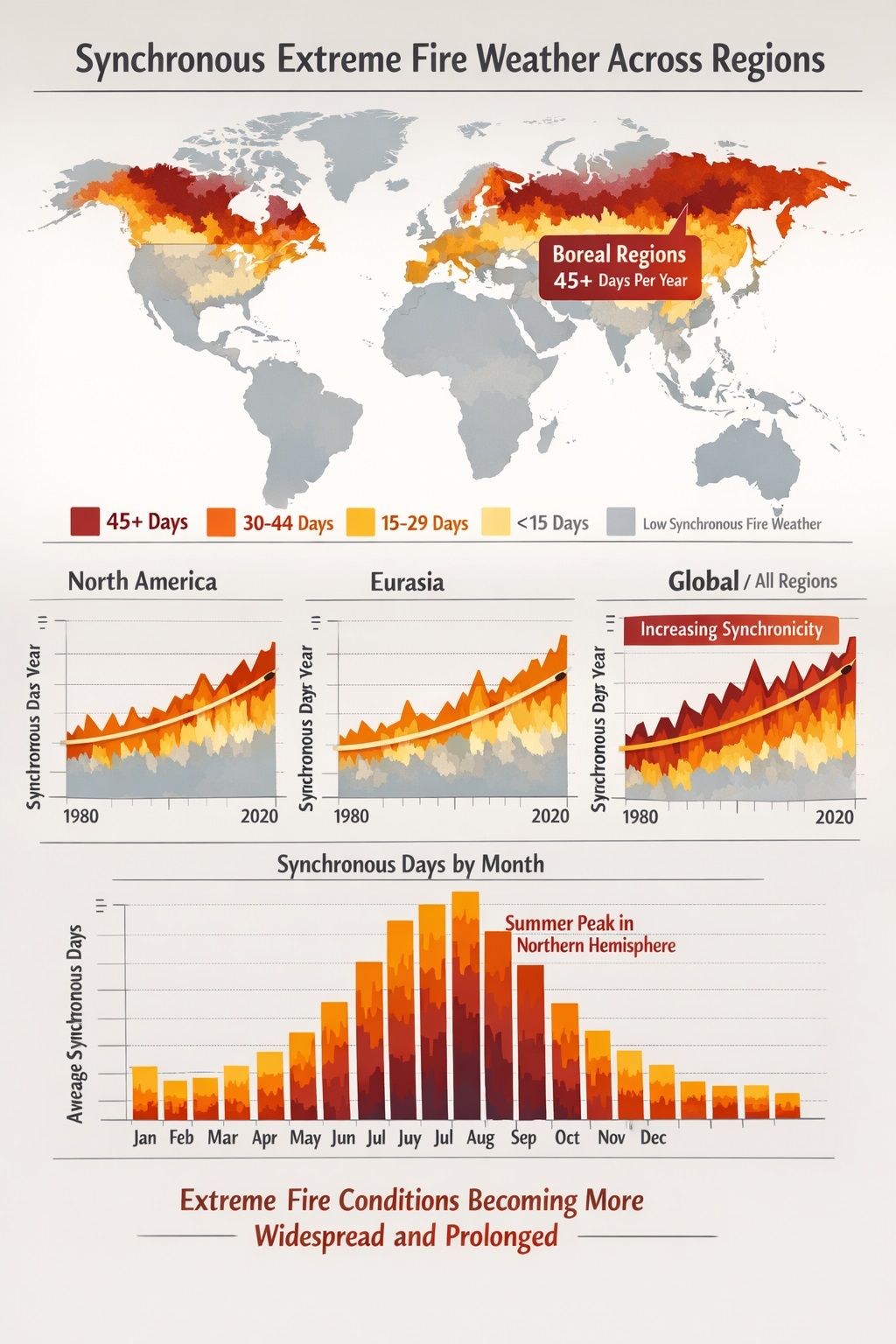
Boreal regions, the vast northern forests of Canada, Russia, and Scandinavia stand out as the places most prone to synchronous fire weather within a single region, averaging more than 45 synchronous days per year. The nature of the subarctic climate means that when summer arrives, it arrives everywhere in the region at once, and the fire danger follows suit.
South America showed the most dramatic overall increase, a trend consistent with the significant warming and drying that has accelerated across the continent. The growing synchronicity between South America and Southern Africa is particularly consequential: together, these two areas account for nearly half of all carbon released globally by fires each year.
Climate Change Is the Main Driver
One of the most significant findings of the study is the attribution of these trends to human-caused climate change. Using a sophisticated counterfactual method essentially asking what the fire weather record would look like if the warming influence of human greenhouse gas emissions were removed — the researchers estimate that anthropogenic climate change accounts for more than half of the observed increase in synchronous fire weather in most regions.
This is not a marginal contribution. It means that the growing danger of simultaneous widespread wildfires around the world is, to a substantial degree, a direct consequence of decisions made about fossil fuels and land use. The warming trend does not just make individual regions hotter and drier; it makes the conditions for extreme fire weather arrive in more places at once, more often.
Global warming accounts for the largest share of year-to-year variability in synchronous fire weather overall, particularly at the interregional scale. The planet's general warming trajectory is pulling more regions toward dangerous fire conditions in the same seasons, regardless of other factors.
El Niño, Ocean Temperatures, and the Wildfire Calendar
Beyond the long-term warming trend, the research identifies several natural patterns of climate variability that strongly influence when and where synchronous fire weather occurs.
El Niño, the periodic warming of the central and eastern Pacific Ocean that reshapes weather patterns across the globe, has a particularly dramatic effect on Equatorial Asia, a region encompassing much of Southeast Asia including Indonesia and the surrounding islands. During El Niño years, intraregional synchronous fire weather days in Equatorial Asia increase by 43 days compared to neutral years. At the same time, the number of days when Equatorial Asia experiences extreme fire weather simultaneously with adjacent regions, Australia, Central and East Asia, and Boreal Asia, increases by 10 to 20 days.
The 2019 to 2020 Australian fire season — the catastrophic "Black Summer" that killed an estimated 34 people directly and caused smoke-related deaths across the country's most populated regions — reached record intensity during a strong positive Indian Ocean Dipole event, another pattern of ocean temperature variation that suppresses rainfall across Australia and Indonesia. The research confirms that such ocean-atmosphere patterns are not just background noise. They are powerful amplifiers of an already worsening trend.
The Indian Ocean Dipole plays a particularly important role in interregional synchronicity, helping to link extreme fire weather across the regions bordering the eastern Indian Ocean. Meanwhile, a third pattern called Tropical Atlantic Variability exerts a comparatively weaker influence.
The Firefighting Coordination Crisis
The research maps out, with uncomfortable specificity, how synchronous fire weather is eroding the international cooperation networks that countries have spent years building.
Portugal and Spain, both members of the European Union's shared firefighting system, experience extreme fire weather on the same day for an average of 19 days per year — and that figure is increasing by three days per decade. The Association of Southeast Asian Nations has developed regional cooperation on forest fire management, but the growing synchronicity among its member countries complicates that coordination.
Perhaps most telling is the situation involving the longest-standing international firefighting partnership: the arrangement between the United States, Canada, Australia, New Zealand, and several other countries that allows crews and resources to flow across borders during fire emergencies. This partnership was built on the assumption that fire seasons in different parts of the world would not overlap in the most dangerous way. That assumption is becoming less reliable every year. The window of opportunity for bilateral cooperation among these countries may be narrowing precisely when the need for it is growing.
Fire Smoke, Air Pollution, and the Human Health Toll
The synchronicity problem does not stop at firefighting logistics. When extreme fire weather strikes a wide area simultaneously, the fires that follow release enormous quantities of smoke, and that smoke does not respect borders or stay put.
The research demonstrates that intraregional synchronous fire weather is strongly linked to regional levels of fine particulate matter, known as PM2.5, the tiny particles in smoke that penetrate deep into lungs and bloodstream and cause serious health damage. In Boreal Asia, for example, 67% of all poor air quality days — defined as days when PM2.5 concentrations exceed the World Health Organization's recommended 24-hour limit — coincide with days of synchronous fire weather. When the threshold is raised to four times the WHO limit, capturing the most extreme air pollution events, the fraction of those days that coincide with synchronous fire weather rises to 95%.
That is an almost complete overlap. The worst air pollution events in Boreal Asia are almost entirely a product of synchronous fire weather.
The impacts on human exposure are equally significant. In Europe, during years when synchronous fire weather days are in the highest 25%, the number of people exposed to fire-sourced air pollution above safe long-term levels is 198% higher than in other years. In Equatorial Asia, northern South America, and Australia, the correlation between synchronous fire weather and population exposure to dangerous levels of smoke is strong and statistically robust.
The research also highlights a troubling dimension of inequality in these health impacts. Regions experiencing greater increases in population exposure to fire smoke tend to have middle to higher income levels, which may provide more capacity to adapt. But many of the regions where fire-sourced air pollution is most severe and synchronous fire weather is most intense are home to populations with fewer resources to cope.
What Needs to Change
The research does not offer easy answers, but it does make the shape of the challenge clear. International firefighting cooperation networks were designed for a world where fire seasons in different hemispheres conveniently offset each other, providing windows for resource sharing. That world is fading. The networks need to be redesigned for a world where multiple regions may be simultaneously overwhelmed.
Early warning systems for synchronous fire weather — the kind that would give governments and fire agencies advance notice that a dangerous convergence is coming are not yet widely operational. The research provides the scientific foundation for building them.
The links between synchronous fire weather, carbon emissions, and global carbon accounting also deserve more attention. The growing synchronicity between fire-prone regions in South America and Africa both being major carbon emission hotspots — means that years of unexpectedly high fire emissions may become more frequent, adding volatility that is not well captured in current global climate models or policy frameworks.
And at the most fundamental level, the research adds to the already substantial evidence that reducing greenhouse gas emissions is not just an abstract moral imperative. It is a practical intervention that would directly reduce the frequency and severity of the synchronous fire weather days that are overwhelming firefighting systems and poisoning the air that millions of people breathe.
A Warning Written in Fire
In the summer of 2021, resource-sharing networks in North America buckled under the pressure of simultaneous fire emergencies. In the 2019 to 2020 Australian fire season, the country's response systems were pushed to their limits by months of record fire activity, while smoke blanketed cities and towns for weeks. These events felt exceptional at the time.
This research suggests they may soon feel routine.
Extreme fire weather is no longer a local problem. It is increasingly a global, synchronized crisis, one that is being intensified by climate change, amplified by natural variability, and outpacing the institutions built to manage it. Understanding the patterns of that synchronicity, as this research now makes possible, is the first step toward building a response worthy of the scale of the challenge.
Publication Details: Year of Publication: 2026; Journal: Science Advances; Publisher: American Association for the Advancement of Science (AAAS); DOI: https://doi.org/10.1126/sciadv.adx8813
Credit & Disclaimer This article is based on the peer-reviewed research paper. All scientific facts, findings, and conclusions are drawn directly from the original study and remain faithful to its content. Readers are strongly encouraged to consult the full research article for complete data, methodology, and supplementary materials.


